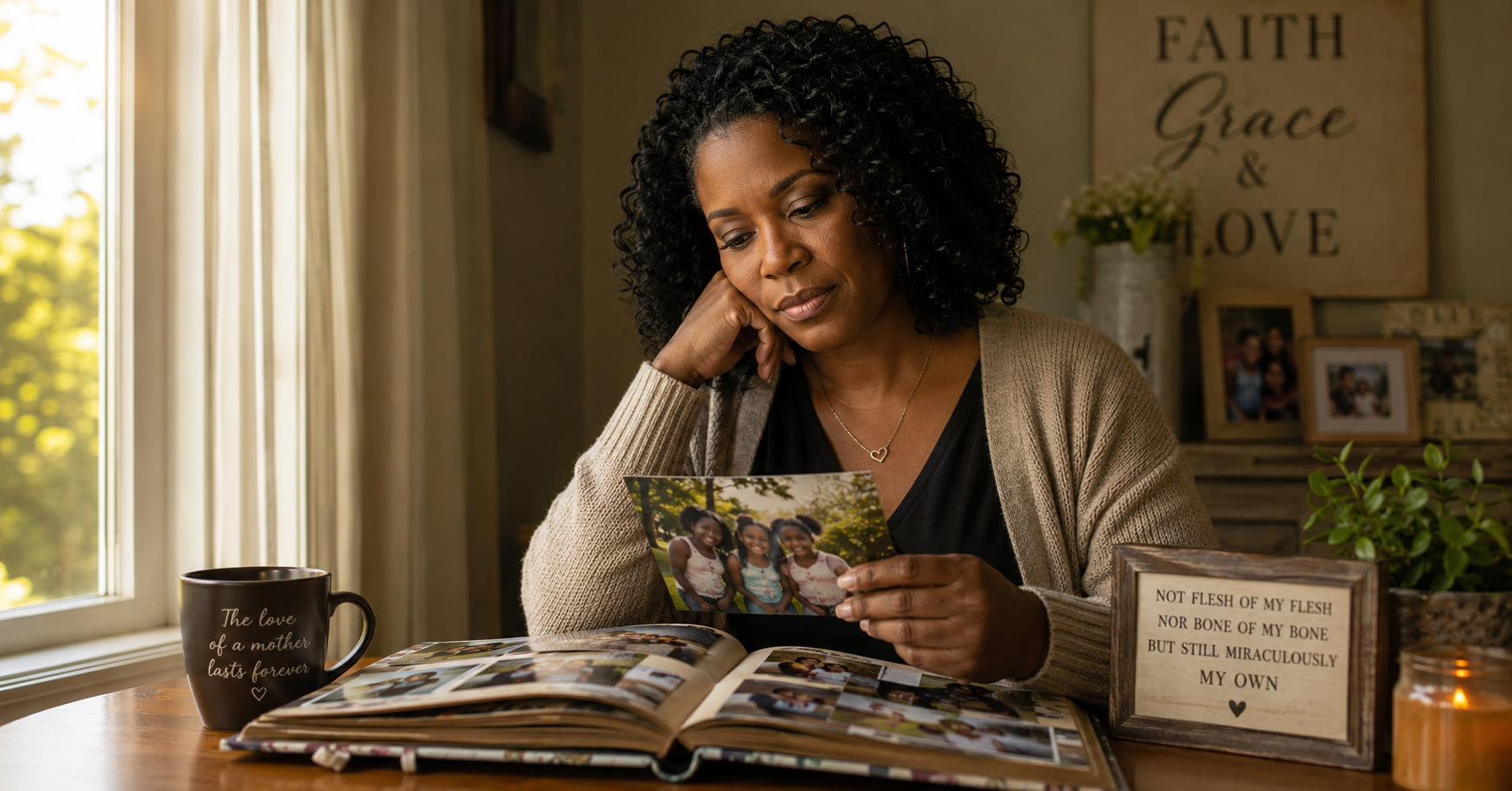
I loved them, sacrificed for them, prayed for them, and raised them as my own. But when rejection came, it forced me to confront the question I had feared all along: Was I really their mother? That question did not begin when our family started to unravel. It had been quietly living in me for years, long before adoption became part of my story.
The Fear I Carried Before Adoption
In my twenties, my biggest fear about adoption was rejection. I wondered whether a child, once grown, might leave the adoptive parents behind to reunite with the biological parents. That possibility felt unbearably painful, so I had no desire to build my family through adoption. If I had been given no other choice, I thought I might feel more comfortable with international adoption because it seemed to lessen the chances that a child would one day leave me.
The Day Their Story Became Mine
Then, in 2012, adoption stopped being a distant fear and became part of my real life. I began attending court proceedings involving my husband’s great-nieces, who had been placed in foster care. The system was seeking a permanent home for them because their biological parents were making no progress toward regaining custody.
The girls were brought to our house so they could meet and play with their extended family. Watching these children, who had already spent a year in the system, jump on the trampoline, race through the basement, play video games, and eagerly eat whatever was set before them filled me with joy. I was amazed by their resilience. Even more than that, I could not understand how their parents were unwilling to do what was necessary to regain custody. At the time, I had been battling infertility for eleven years, and it was incomprehensible to me that any mother would walk away from the gift of raising her children.
That summer, an unexpected turn of events in court changed everything: the judge awarded my husband and me custody of the girls. Before leaving the courtroom, I asked the Deputy Juvenile Officer (DJO) whether she thought the birth mother would return. She said, “Mrs. Barnes, I have been doing this work for a decade, and I have never seen a parent in her situation regain custody.” Her words soothed the fear I had carried for so long. For the first time, I began to accept in my heart that I would be adopting three girls.
Building an Instant Family
Although my husband and I had not given up our dream of having a baby, I knew this was not the right season to continue fertility treatments. We needed time to build our instant family. So we stepped away from treatment and placed that desire in God’s hands, hoping He might still bless us the old-fashioned way.
Like most adoptions involving elementary-aged children, ours came with major adjustments. The girls barely knew us, and we had seen them only a handful of times before they entered foster care. New rules, daily structure, and learning how to live together quickly consumed our world. We were building a family with the tools we had and with unwavering love.
Some days were good, some were bad, and some were downright ugly. Still, we kept pressing forward together. Each hard-won victory seemed to bind us more closely, and eventually the good days began to outnumber the bad. My love for the girls deepened with every passing day.
We took family vacations, and laughter filled our home. The younger girls would say things like, “God moved us here to get love,” and “I think you are the best mommy ever!” The oldest daughter began giving me hugs and kisses and let me do her hair. I treasured our heart-to-heart talks and the family we were becoming.
The girls did not feel like children I had adopted; they felt like my own. I never told anyone who did not already know our story that the girls were adopted. For a time, our home finally felt like a family. But after a couple of years, that bond was interrupted and tested.
When the Birth Mother Returned
A few months after the adoption was finalized, that sense of stability began to unravel when the birth mother unexpectedly resurfaced. She started asking to see the girls and insisting that she needed to be part of their lives.
I felt torn. Should she have a place in their lives simply because she had given birth to them? Or should I protect them from her because she was not the kind of person I would have allowed around a biological child of mine?
I had very little experience with adoption or with relationships between adoptive and biological parents, so I prayed. For the girls’ sake, I felt compelled to try to blend our worlds. But that was difficult because the birth mother and I were different in so many ways—age, ethnicity, personality, and parenting style.
It did not take long to realize that our worlds could not peacefully coexist with the tools we had. Her words and actions made it clear that she did not respect me as their mother, while I believed her new role should be no more than that of an extended family member. After she stalked our home and the places we frequented, a restraining order was granted.
But the damage had already been done. Her actions created conflict between us and the girls, and as we struggled to steady our family again, her words haunted me: “I’m their mom, and you’re their aunt.”
“I’m Their Mom, and You’re Their Aunt”
I asked God whether she was right. Am I their mother? I felt like their mother. I truly loved them as a mother, not as an aunt. My financial sacrifices, late nights of teaching, and daily nurturing all felt like the work of a mother.
Yet this question plagued my mind, and the oldest daughter’s disapproval of my parenting, along with people’s whispers about how we had barred the birth mother from the children, fed my doubts. On a few occasions, when the two oldest girls received consequences for their behavior, they said they were going to leave and reunite with their birth mother. I assumed they knew those words were hurtful, but I did not take them seriously.
Watching My Family Slip Away
Once the oldest child turned seventeen, our family dynamics began to spiral downward. I overheard the girls telling others that they had been taken from their birth mother. They implied that they had been forced to call us “Mom” and “Dad.”
Eventually, during a high-charged conversation, the eldest said she would never be my daughter. Reality set in in a brutal way: what I had feared was beginning to take shape in ways I could no longer ignore. I was heartbroken in a way I had never experienced before. How can you mother children for years and still be rejected? How could they believe you were not their mother?
It was emotionally exhausting to keep parenting the girls as they pulled farther and farther away from me. My presence was no longer welcome, and all I seemed to feel from them was hostility. We were merely coexisting in the same house, and the tension was palpable.
It felt as though I were mothering terminally ill children because once the eldest left, I feared the others would follow. In my mind, my children would die at eighteen, leaving me only with memories.
To soothe my soul, I began scrapbooking our Christmases, vacations, and birthday celebrations. I wanted to preserve the good times. My soul ached in a way I still do not know if I can fully describe.
God’s Answer in the Middle of Grief
I took this immense grief to God. Should I keep forcing myself into their lives? Should I keep trying to convince them that I was their mother?
In that place of anguish, I heard the Holy Spirit speak words that brought both comfort and clarity: “Sometimes being a great mom means letting your children go.”
Those words gave me the framework I needed to reshape my thinking. So I prayed again: “What should I do?” because I still had some mothering left in me.
Rejection Became Redirection
During that season, my husband and I decided to return to the infertility clinic. The timing felt right because the girls had distanced themselves, and for the first time in years, we sensed God redirecting us.
We were given only a small measure of hope, but we clung to it like a lifeline. Looking back now, I can say that what felt like rejection was also redirection. God used that painful season to place us back on a path we had once laid aside.
Then, two years before the third adoptee left our home, God blessed us with the conception of a baby girl.
I Carried Them Too
As I parent my biological child, I realize that my love for all of my children is the same.
I carried one in my physical womb.
And I carried three in an intangible one.
In many ways, the season leading up to the girls’ adoption felt like its own kind of pregnancy. Instead of doctor visits, I attended meetings with caseworkers, therapists, and a guardian ad litem who updated me on their growth and development.
Before they moved in, I designed their bedrooms and bathroom to reflect their little personalities. I bought clothes and toys. I even had an adoption party, which felt in many ways like a baby shower.
Every court proceeding leading to the adoption carried its own kind of labor pain. I was exhausted, yet full of hope as I watched them grow. Other similarities—like giving them a portion of our names—remain deeply meaningful to me.
I never stopped loving my three girls. When they first left, I found myself asking God, What happened? Was I really their mother?
The Story of Solomon Changed Everything
Recently, I reread the story of King Solomon, who was asked to determine the baby’s real mother (1 Kings 3). In that story, I believe I found my answer.
The true mother was not the one who simply claimed the child; she was the one willing to sacrifice her own desire in order to spare the child’s life.
That is how I have come to understand motherhood. It is proven through love, selfless care, and the willingness to suffer for a child’s well-being—not by biology alone.